Subterranean termite activity in Boston centers primarily on the eastern subterranean termite (*Reticulitermes flavipes*), which nests deep in damp subterranean soil and establishes shelter tubes up masonry foundation…
Subterranean termite activity in Boston centers primarily on the eastern subterranean termite (*Reticulitermes flavipes*), which nests deep in damp subterranean soil and establishes shelter tubes up masonry foundation walls to reach load-bearing floor joists, sill plates, and wall framing. In dense historic neighborhoods such as Beacon Hill, Back Bay, and the North End, structural timbers frequently interface directly with damp rubble-stone, fieldstone, or granite foundations. Moisture migration through aging mortar beds creates ideal relative humidity for worker termites, who consume the interior cellulose while leaving an intact outer veneer of wood, concealing hollow damage until structural sag occurs. In the wood-framed triple-deckers of Dorchester, South Boston, and Jamaica Plain, dirt-filled front porches, ground-contact deck footings, and uninsulated crawlspaces offer direct, concealed pathways from high-moisture urban soil into primary architectural framing.
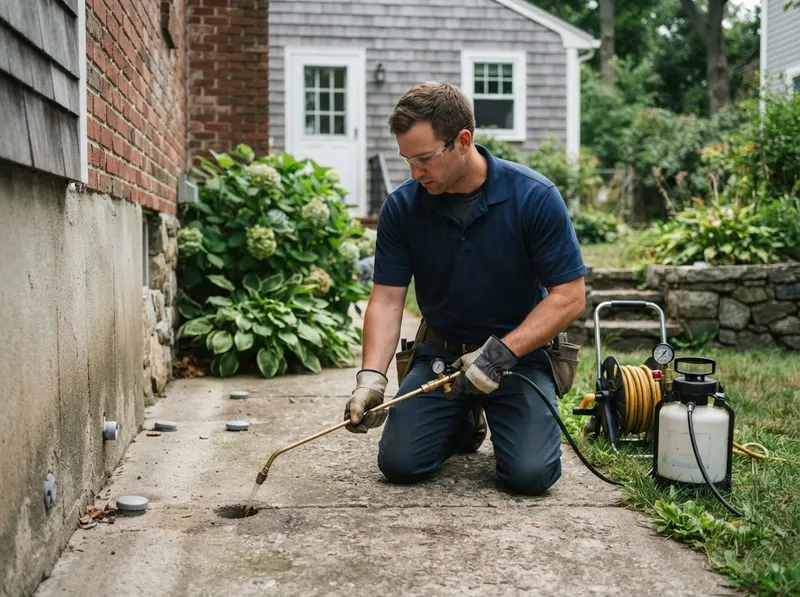
Effective defense requires isolating the building framing from subterranean colonies using localized perimeter engineering rather than broad internal fogging. Perimeter liquid barrier defense involves cutting a 6-inch-wide by 6-inch-deep trench in exposed earth along the foundation, or precision drilling through exterior concrete walkways every 12 inches to inject a continuous non-repellent liquid termiticide into the backfill. Worker termites cannot detect the agent, meaning they walk through the zone, transfer the slow-acting compound back to the central subterranean queen through social grooming, and collapse the reproductive colony within 60 to 90 days. For structures adjacent to sensitive root systems, brick courtyards, or zero-lot-line townhomes in Charlestown and Roxbury where perimeter excavation is physically restricted, tamper-resistant monitoring and baiting stations are cored directly into turf or brick pavers at 10-foot to 15-foot intervals. Termites feed on compressed cellulose rods laced with chitin synthesis inhibitors, terminating their molting process without introducing chemical saturations near indoor living zones.
Selecting between continuous chemical barrier trenching and perimeter bait stations depends on foundation construction type and exterior footprint access. Continuous liquid barrier application delivers immediate protective containment around poured concrete foundations common in Brighton and Allston, but historic granite block foundations often allow chemical leaching through shifting mortar voids. In those masonry settings, bait stations provide target-specific colony elimination without injecting pressurized liquids against basement living areas, though they require scheduled monitoring checks across a 3-month to 6-month establishment curve. Structural spot injection of non-repellent foaming agents directly into damaged floor beams stabilizes acute framing infestations while the exterior soil defense system permanently breaks ground-level subterranean access.
Every job gets a firm, written price after a free on-site visit.
Tell us about your subterranean termite treatment job in Boston and we'll send a clear, written quote, usually the same day.
 Kervano Pest Specialists