Kervano Pest SpecialistsKervano Pest Specialists

Residential Rodent Exclusion Boston

Residential rodent exclusion stops ongoing home invasions by addressing the architectural breaches common to Suffolk County housing stock. In historic fieldstone and brick rubble foundations across Beacon Hill, the…
Get My Free Estimate →(857) 737-8398
Residential Rodent Exclusion in Boston, MA
Quick answer
  • What is included: Full exterior foundation sweep, interior utility line inspection, mechanical sealing of gaps down to one-quarter inch, and structural hardware cloth installation.
  • How fast: On-site evaluations take 45 to 90 minutes; structural sealing protocols are executed within 24 to 48 hours of assessment.
  • What it costs: Ballpark pricing ranges from $350 to $1,800 depending on structural perimeter size, with a strict $200 minimum assessment and spot-seal charge.
  • Target pests: Norway rats (Rattus norvegicus) and house mice (Mus musculus) invading residential building envelopes.
  • How to schedule: Call (857) 737-8398 or text exterior foundation photos to arrange a direct inspection with Kervano Pest Specialists.

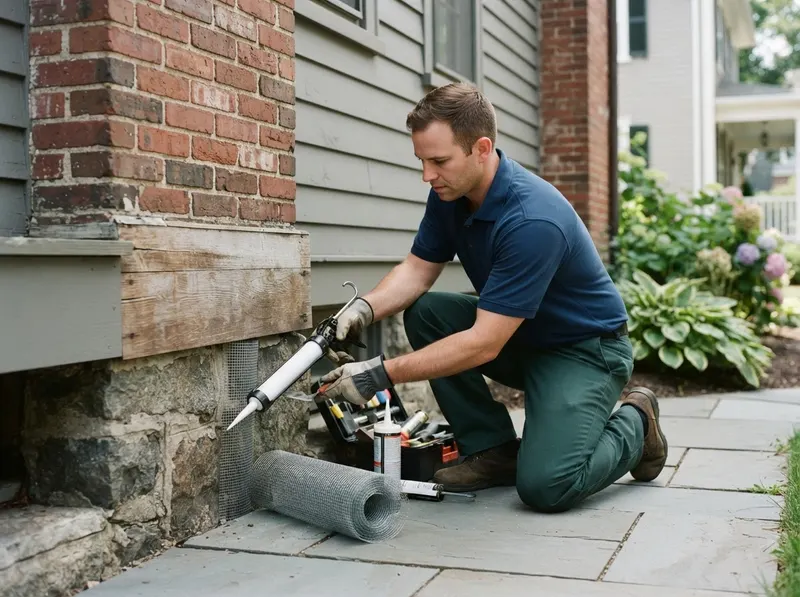
Residential rodent exclusion stops ongoing home invasions by addressing the architectural breaches common to Suffolk County housing stock. In historic fieldstone and brick rubble foundations across Beacon Hill, the North End, and Charlestown, mortar leaches out over decades, leaving subterranean gaps exceeding one-half inch. Norway rats leverage these voids alongside sewer laterals, while house mice exploit gaps as narrow as one-quarter inch around gas risers, radiator lines, and deteriorated sill plates in Dorchester triple-deckers and South Boston multi-family properties. Trapping programs reduce existing populations indoors, but without physical exclusion, structural drafts and food aromas continuously pull new colonies from neighboring alleyways and MBTA rail corridors. The mechanical exclusion method substitutes temporary poison baits with 19-gauge galvanized hardware cloth, silicone-embedded copper mesh, and elastomeric sealants that rodents cannot chew through.

Selecting permanent structural exclusion over recurring chemical bait programs eliminates the risk of indoor rodent expiration inside drywall bays, which prevents persistent carcass odors and secondary insect infestations in living areas. Chemical-free physical barriers also remove non-target toxicity risks for household pets and young children. For single-family residences in Jamaica Plain, West Roxbury, and historic row houses in Back Bay, entry-point engineering covers foundation air vents, bulkheads, masonry seams, and utility entry penetrations. If a structure exhibits active burrows beneath granite slab steps or voids around subterranean stone masonry, mechanical trenching and wire-barrier installation protect the sub-grade envelope.

Step-by-step exclusion sequence:

1. Foundation and roofline mapping: Technicians identify every gap wider than one-quarter inch from grade to soffit line, logging chimney flashings, crawlspace penetrations, and utility conduits.

2. Barrier material installation: Technicians pack openings with woven copper gauze, anchor galvanized steel hardware cloth, and top-seal gaps with hydraulic cement or rodent-proof elastomeric foam.

3. Utility line and pipe escorting: High-heat conduits, plumbing waste lines, and HVAC copper lines are secured using metal escutcheon plates and high-density backer rod.

4. Interior interior chamber clearance: Active populations trapped inside the envelope are captured via mechanical snap arrays within 7 to 14 days, verifying zero sound or movement in ceiling voids.

Residential Rodent Exclusion cost in Boston

Initial Structural Rodent Evaluation & Single-Point Spot Seal$200 to $325
Attached Townhome / Rowhouse Foundation Exclusion (Back Bay, South End)$450 to $950
Three-Family / Multi-Unit Sub-Sill Perimeter Sealing (Dorchester, South Boston)$750 to $1,400
Comprehensive Fieldstone Basement Trenching & Full Envelope Fortification$1,200 to $2,400

Every job gets a firm, written price after a free on-site visit.

Common questions

How much does residential rodent exclusion cost in Boston?
Residential rodent exclusion in Boston ranges from $350 to $1,800 for standard residential structures, anchored by a $200 absolute minimum service fee for targeted entry-point repairs. Total fees depend on the linear footage of the perimeter foundation, basement depth, and whether a historic fieldstone mortar wall requires tuckpointing and hardware cloth reinforcement.
Why do mice keep re-entering Boston brownstones after extermination?
Mice re-enter Boston brownstones because shared party walls, subterranean foundation voids, and sub-floor pipe chases create open continuous highways between neighboring buildings. Chemical treatments only kill the rodents present at that moment; unless penetrations around steam pipes, gas mains, and sill plates are mechanically capped with metal fabric, exterior rodents repopulate the rooms within weeks.
Is mechanical rodent exclusion safe for indoor pets in Boston homes?
Mechanical rodent exclusion is completely non-toxic and structurally inert, making it harmless to dogs, cats, and small children. The process relies exclusively on 19-gauge galvanized mesh, copper wire weave, cementitious compounds, and metal plates to block entry rather than dispersing broadcast anticoagulant rodenticides or loose neurotoxin baits indoors.
How does weather in Boston impact residential rodent exclusion timing?
Dropping fall temperatures along Massachusetts Bay drive rodent populations indoors from September through December, making pre-freeze sealing critical. Exterior masonry work and hydraulic cement applications require ambient temperatures above 40 degrees Fahrenheit to cure properly, though sub-sill wire mesh fastening and interior baseline exclusions operate without seasonal interruption through winter.
What is the difference between rodent control and rodent exclusion in Boston?
Rodent control is population management through traps or chemical baits, whereas rodent exclusion is permanent architectural carpentry and masonry repair that denies physical entry to the structure. Trapping handles interior mice currently residing inside wall voids, while exclusion locks out the exterior reservoir of municipal rats and neighborhood field mice permanently.
Helpful resources

Trusted references & local links

USA.gov, government & consumer helpBetter Business BureauFTC Consumer AdviceU.S. Small Business AdministrationReady.govU.S. EPAENERGY STARU.S. Dept. of EnergyConsumer.govU.S. Census BureauGoogle Maps, Boston, MA

Get started today

Tell us about your residential rodent exclusion job in Boston and we'll send a clear, written quote, usually the same day.

Get your free PEST CONTROL SEVICE quote, Boston

We only use your ZIP to check availability, no spam.