Carpenter ants do not ingest cellulose like subterranean termites; instead, Camponotus pennsylvanicus workers excavate smooth, gallery-style tunnels through structural timbers to establish nesting chambers. In historic…
Carpenter ants do not ingest cellulose like subterranean termites; instead, Camponotus pennsylvanicus workers excavate smooth, gallery-style tunnels through structural timbers to establish nesting chambers. In historic architecture such as the brick-and-beam row houses of Beacon Hill, Back Bay brownstones, and three-deckers in Dorchester and South Boston, moisture retention frequently softens structural components. Common failure zones include exterior wall sills, historic flat-roof interfaces near the Rose Kennedy Greenway, and ground-level joists in Charlestown basements. Store-bought repellent sprays fail in these settings because they isolate worker ants, prompting colony budding where single nests fragment into multiple autonomous satellite colonies hidden behind lath-and-plaster or horsehair-plaster walls.
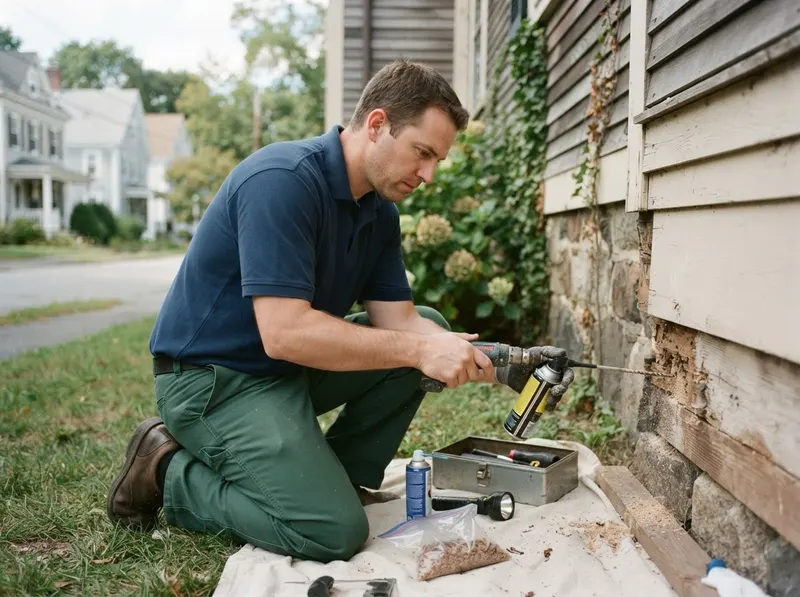
Selecting structural remediation rather than topical pest spraying addresses the core mechanics of the colony. Standard surface treatments affect only the 10% to 15% of the colony actively foraging for carbohydrates. Structural remediation deploys undetectable, non-repellent materials engineered for transfer dynamics: foraging workers carry the active ingredients directly into interior wall cavities, cross-contaminating the reproductive queens and pupae inside primary nests. In situations involving localized window frame moisture in Jamaica Plain or rear-deck support beams in Allston and Brighton, targeted drilling and precise void injection neutralizes nesting chambers without requiring large-scale drywall demolition. When water intrusion has compromised structural framing over multiple seasons, mechanical wood restoration must accompany biological removal to restore load integrity.
Remediation protocols proceed in sequential stages. First, acoustic detection and non-invasive moisture meters trace hidden galleries behind historic paneling and modern sheetrock without surface damage. Second, technicians execute micro-injections directly into confirmed voids using low-toxicity formulations selected for low mammalian impact, protecting indoor household environments. Third, technicians document exterior access corridors, including tree canopies touching roof eaves near the Arnold Arboretum or rotted fascia along Roxbury framing, providing clear architectural correction steps. Service calls can be arranged through Kervano Pest Specialists by calling (857) 737-8398.
Every job gets a firm, written price after a free on-site visit.
Tell us about your carpenter ant structural remediation job in Boston and we'll send a clear, written quote, usually the same day.
 Kervano Pest Specialists